

By The FoodsUse Editorial Team
Do you feel like you have less strength than you did ten years ago? Perhaps carrying groceries feels heavier, or getting up from a low chair takes more effort.
Many older adults accept this as an inevitable part of aging. But nutrition science in 2026 tells a different story. Much of this weakness isn’t just “getting old”—it is a condition called sarcopenia (age-related muscle loss), and it is largely preventable.
In our comprehensive guide to the 2026 Healthspan Diet, we listed the best superfoods for seniors. But when it comes to fighting muscle loss, what you eat is only half the battle. When and how much you eat matters just as much.
If you want to protect your independence and vitality after 60, you need to know about the “30-Gram Rule”—and why breakfast is the most critical meal of the day to apply it.
The Hidden Obstacle: Understanding Anabolic Resistance
Why can a 25-year-old eat a piece of toast for breakfast and maintain muscle, while a 65-year-old cannot?
The answer lies in a biological change known as anabolic resistance.
Think of your muscle-building process like a light switch. When you eat protein, it flips the switch “on,” telling your body to repair and build muscle tissue.
-
In a young person, that switch is highly sensitive. A small amount of protein flips it on easily.
-
After age 60, that switch becomes “rusty” or resistant. It takes a much stronger push—a larger dose of protein all at once—to flip the switch on.
If you don’t eat enough protein in a single sitting to overcome this resistance, your body stays in a catabolic state, meaning it continues to break down muscle for energy instead of building it.
Common anabolic resistance symptoms include generalized weakness, slower recovery after activity, and noticeable shrinkage in muscle tone in the arms and legs.
The 30-Gram Rule Explained (The Science)
So, how much protein to build muscle after 60 is actually required to flip that “rusty switch”?
Current research suggests the magic threshold is roughly 25 to 30 grams of high-quality protein in a single meal.
This amount is necessary to provide enough of an amino acid called Leucine. Leucine acts as the key that unlocks the muscle-building process. If you only eat 15 grams of protein, you don’t get enough leucine to turn the key, and muscle repair doesn’t happen.
This is why the old advice to just “eat a little protein throughout the day” fails many seniors. Snacking on 5 grams here and 10 grams there never triggers the muscle-building threshold.
ALSO READ:Why Ultra-Processed Foods Are Quietly Ruining Your Health in the U.S. and UK
The “Breakfast Gap”: Where Most Seniors Go Wrong
This is where breakfast becomes the critical battleground for your health.
After sleeping for 8 hours, your body is in a fasted state and is actively breaking down muscle tissue. You need to reverse this process immediately upon waking.
Unfortunately, the typical Western breakfast is a disaster for muscle maintenance. Look at the protein counts of common breakfasts for seniors:
-
Oatmeal made with water: ~5 grams of protein.
-
Two slices of toast with jam: ~6 grams of protein.
-
One egg and a banana: ~8 grams of protein.
None of these come close to the 30-gram threshold. By starting your day this way, you miss the most important opportunity to protect your muscle mass.
If you wait until dinner to eat your big protein meal, you have spent the entire day in a muscle-wasting state. You must front-load your protein.
5 High-Protein Breakfast Ideas for Seniors
Changing your breakfast habit is the single most effective dietary step you can take to fight sarcopenia.
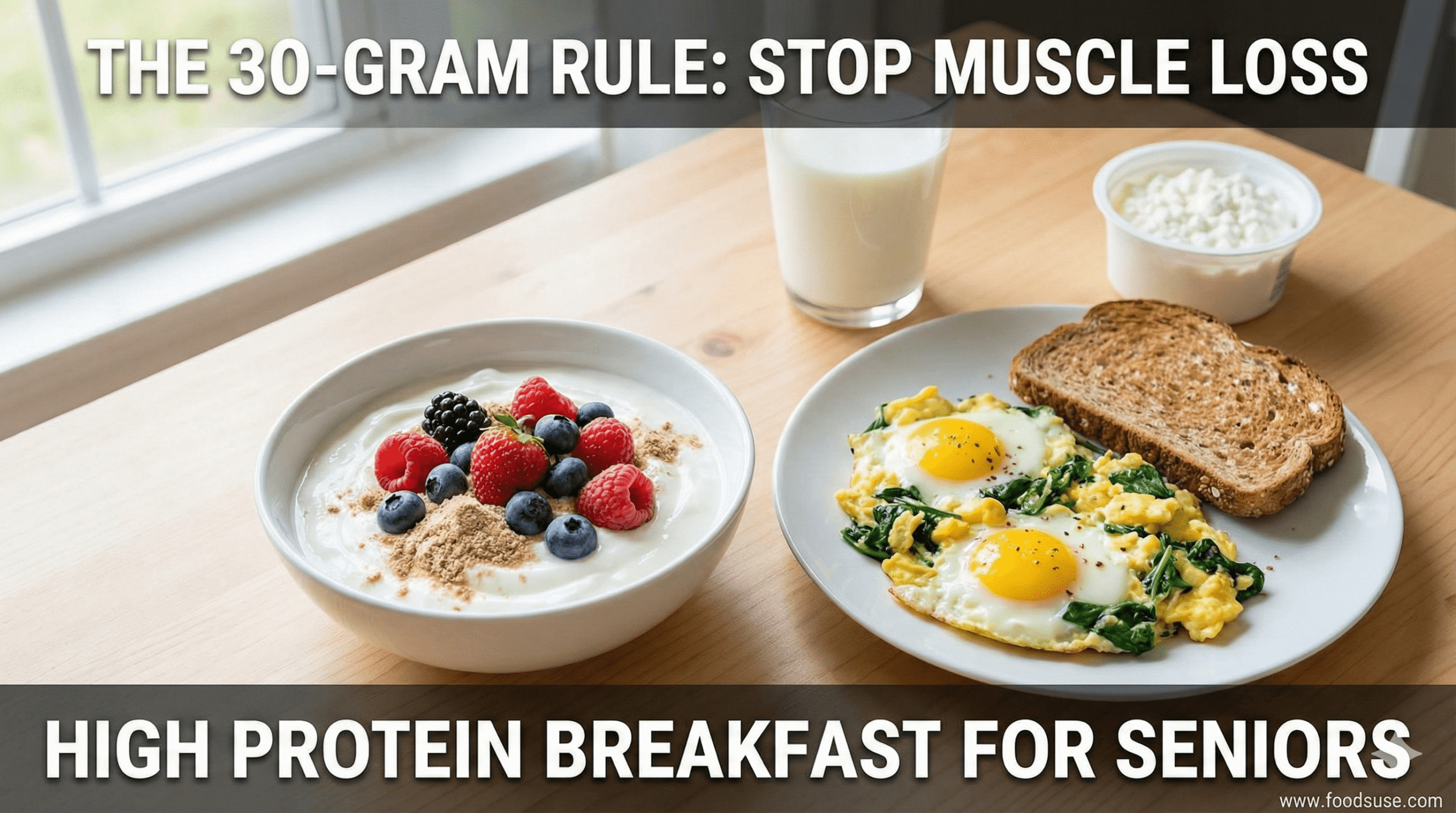
Here are 5 practical, delicious examples of a high protein breakfast for seniors that hits the 30-gram goal. These utilize some of the best protein sources for seniors that are easily digestible and budget-friendly.
1. The Greek Yogurt Power Bowl
Greek yogurt is strained, making it much higher in protein than regular yogurt.
-
The Meal: 1 cup of plain non-fat Greek yogurt (approx. 20g protein) mixed with 1 scoop of whey or collagen protein powder (approx. 10-15g protein).
-
Add-ins: Top with the frozen berries mentioned in our Healthspan Diet guide for brain-boosting antioxidants.
-
Total Protein: ~30–35g
2. The “Three-Egg Plus” Scramble
One egg only has 6 grams of protein. To hit 30g, you need to bulk it up.
-
The Meal: 3 large eggs scrambled (18g protein) mixed with 1/4 cup of shredded cheddar cheese (7g protein) and a side of thin-sliced smoked salmon (5g protein).
-
Add-ins: Stir in spinach for extra vitamins.
-
Total Protein: ~30g
3. Cottage Cheese Pancakes
If you prefer a sweeter breakfast, cottage cheese is a secret weapon. It is rich in casein protein, which is excellent for older adults.
-
The Meal: Blend 1/2 cup of cottage cheese (12g protein), 2 eggs (12g protein), and 1/4 cup of oats. Cook like regular pancakes.
-
Total Protein: ~25–28g (Add a side of Greek yogurt to push it over 30g).
4. Pro-Oats (Protein Oatmeal)
Regular oatmeal won’t cut it, but you can fortify it.
-
The Meal: Cook 1/2 cup of oats using milk instead of water (8g protein from milk). Once cooked, stir in 1 scoop of vanilla protein powder (20g protein) or 1/2 cup of liquid egg whites (pasteurized so they are safe) while cooking for creaminess.
-
Total Protein: ~30g
5. The Savory Fish on Toast
As we highlighted in our pillar article, canned fish is a cheap superfood.
-
The Meal: Two slices of high-protein whole-grain bread (check labels, some have 5g per slice = 10g) topped with a full can of sardines or mackerel in tomato sauce (approx. 20g protein).
-
Total Protein: ~30g
A Note on Protein Powders and Shakes
Sometimes, appetite decreases with age, and eating a large meal first thing in the morning feels difficult.
In these cases, high-quality protein powders (whey isolate, casein, or plant-based blends like pea and rice protein) are excellent tools. They are easy to digest and ensure you hit your 30-gram target without feeling overly full. They should not replace whole foods entirely, but they are a convenient “insurance policy” for your muscles on busy mornings.
ALSO READ: The 2026 ‘Healthspan’ Diet: 7 Cheap Superfoods That Fight Muscle Loss & Brain Fog After 60
Conclusion: Try the 1-Week Challenge
Overcoming anabolic resistance doesn’t require a complete lifestyle overhaul. It just requires changing how you start your day.
For the next week, commit to the 30-Gram Rule at breakfast. Use the examples above, and pay attention to how you feel. Many seniors report feeling more energized throughout the morning and less hungry before lunch.
By making this small change, you are no longer accepting muscle loss as inevitable—you are actively fighting back with every bite.
Be the first to get new scholarships, job updates, inspiring Fazza poems, lifestyle stories, and more — straight to your inbox.