


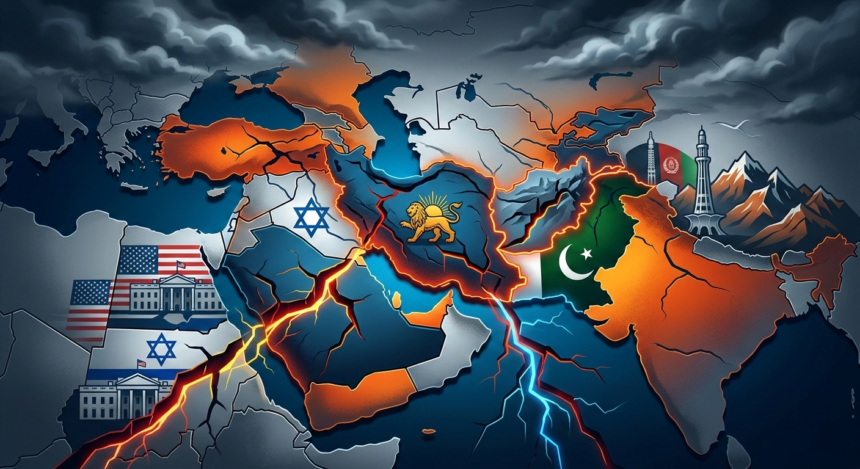
The world is currently witnessing a major geopolitical crisis in March 2026. Two severe conflicts have escalated at the exact same time and this have caused 2026 global conflicts, creating massive ripples across the globe. In the Middle East, a direct military confrontation has broken out involving the United States, Israel, and Iran. Meanwhile, in South Asia, neighboring nations Pakistan and Afghanistan have entered a state of open military conflict.
This rare and simultaneous outbreak of regional wars has put international relations on edge. Global markets are shaking, and ordinary people in these regions are facing daily challenges. This article provides a clear, fact-based, and neutral overview of the current global conflict. We will look at the root causes, timeline of events, verified impacts, and safety strategies for civilians caught in the crossfire.
Background and Root Causes of the Conflict
To understand the current crisis, we must look at the long-standing tensions in both regions. The events of early 2026 did not happen overnight. They are the result of years of political disagreements, security fears, and failed diplomatic talks.
The Middle East Crisis: United States, Israel, and Iran
The conflict between the United States, Israel, and Iran is rooted in deep security concerns regarding Iran’s nuclear and ballistic missile programs. For years, the US and Israel have stated that they will not allow Iran to develop a nuclear weapon. Iran, on the other hand, has always maintained that its nuclear program is for peaceful purposes.
In early February 2026, indirect nuclear talks between the US and Iran completely broke down. The US demanded an end to all nuclear enrichment, while Iran resisted these terms. At the same time, Iran was facing severe internal pressure. Late 2025 and early 2026 saw massive domestic protests in Iran driven by a struggling economy and infrastructure issues. Viewing the regime as vulnerable and a persistent threat, the US and Israel planned a coordinated military intervention to dismantle Iran’s nuclear capabilities and force a change in leadership.
ALSO READ: 25 Best Ramadan 2026 Recipes for Suhoor and Iftar That Will Transform Your Fast
The South Asia Crisis: Pakistan and Afghanistan
The conflict between Pakistan and Afghanistan centers around border security and militant groups. The two countries share a long, disputed border known as the Durand Line. For years, Pakistan has accused the Taliban-led Afghan government of allowing militant groups, specifically the Tehreek-e-Taliban Pakistan (TTP), to use Afghan soil as a safe haven to launch attacks into Pakistan.
Afghanistan has repeatedly denied these claims, stating that it does not allow anyone to use its territory to threaten other nations. Tensions boiled over after a series of deadly attacks on Pakistani security forces in early 2026. Pakistan decided to take direct military action to eliminate these alleged militant camps, while Afghanistan viewed this as a direct violation of its national sovereignty.
Timeline of How the Situation Escalated
2026 Global Conflict: A Comprehensive Overview
The events of late February and early March 2026 moved very quickly. Here is a timeline of how the dual crises escalated into full-scale conflicts:
-
Mid-February 2026: Diplomatic talks regarding Iran’s nuclear program fail. In South Asia, militant attacks on Pakistani forces increase, leading to harsh warnings from Islamabad to Kabul.
-
February 21–23, 2026: Pakistan launches its first wave of airstrikes into Afghan provinces like Nangarhar, Paktika, and Khost. Pakistan claims to target militant camps, but the UN reports civilian casualties.
-
February 24–26, 2026: Afghan forces return fire across the border. Both sides claim the other started the shooting. The Taliban government heavily condemns Pakistan’s actions.
-
February 27, 2026: Pakistan’s Defense Minister officially declares an “open war” with Afghanistan. Reports emerge of Pakistani jets flying over major Afghan cities like Kabul and Kandahar.
-
February 28, 2026: The Middle East crisis explodes. The US and Israel launch “Operation Epic Fury,” a massive military campaign targeting Iran’s leadership, missile sites, and naval bases. In the strikes, Iran’s Supreme Leader, Ayatollah Ali Khamenei, is killed.
-
March 1–2, 2026: Iran declares 40 days of mourning and launches retaliatory ballistic missile strikes against Israel and US military bases in the Gulf states. Meanwhile, fighting intensifies on the Pakistan-Afghanistan border, with the Taliban claiming to have captured several Pakistani military posts.
Key Events and Military Developments
The military actions in both theaters of war have been swift and highly destructive.
Operation Epic Fury in the Middle East
On February 28, the joint US and Israeli forces began hitting key targets inside Iran. According to official statements, the goal was to neutralize the Islamic Revolutionary Guard Corps (IRGC) Navy, destroy missile launch sites, and cripple the nuclear program. US President Donald Trump announced that the strikes had sunk multiple Iranian naval vessels.
Iran responded rapidly. The Iranian military fired advanced ballistic missiles and drones at Israel and US installations across the Persian Gulf. Missiles successfully bypassed some defense systems, hitting areas in Israel such as Beit Shemesh, and causing explosions near US bases in Gulf countries like the UAE and Bahrain. Iran has also threatened to choke the Strait of Hormuz, a critical waterway for the global oil supply.
RELATED ARTICLE : The Modern Prince: Inside the Extraordinary Life of Sheikh Hamdan (Fazza)
The Pakistan-Afghanistan Border War
In South Asia, Pakistan expanded its airstrikes beyond the immediate border region, bombing targets near the Afghan capital of Kabul and the southern stronghold of Kandahar. Pakistan claims these strikes have killed dozens of militants.
The Afghan Defense Ministry retaliated by attacking Pakistani military positions along the Durand Line. Taliban forces claim to have killed over 50 Pakistani soldiers, captured military vehicles, and taken over several border posts. While these numbers are heavily disputed, it is clear that heavy ground fighting is taking place alongside the aerial bombardments.
Verified Damage, Economic Impact, and Casualties
The human and economic costs of these conflicts are already significant, though exact numbers are difficult to verify independently during active combat.
Human Casualties
In the Middle East, the most notable casualty is Ayatollah Ali Khamenei, Iran’s supreme leader. However, civilian lives have also been lost. Reports indicate that over 150 people were killed in Iran, including children at a school in Minab that was caught in the strike zone. In Israel, retaliatory strikes claimed at least nine civilian lives.
In Afghanistan, the United Nations confirmed that at least 13 civilians, including women and children, died in the initial Pakistani airstrikes. Pakistani forces have also suffered casualties in border clashes with the Taliban, and several civilians in border towns have been displaced by the heavy shelling.
Infrastructure and Economic Impact
Military infrastructure in Iran has taken a heavy hit, with missile production facilities and naval bases largely destroyed. In the Gulf, commercial and military zones face the constant threat of drone strikes.
The global economic impact is massive. The Persian Gulf handles about 20% of the world’s oil. With the Strait of Hormuz under threat, global energy markets are experiencing extreme price jumps. In South Asia, border closures between Pakistan and Afghanistan have completely halted regional trade, causing food prices to spike and worsening the already fragile economies of both nations.
Whom They Have Killed
The human cost here is also very high. Pakistan’s government stated they have lost over a dozen soldiers, but they claim to have defeated over 400 Afghan fighters. Meanwhile, the Afghan government says Pakistan’s bombs have taken the lives of many innocent civilians, including women and children, across multiple provinces. The exact numbers are hard to know because both sides tell different stories, but the reality on the ground is full of tears and loss. Who is coming out on top?
Geopolitical Analysis: Gaining and Losing Influence
These conflicts are reshaping global power dynamics and regional influence.
The Middle East
The United States and Israel are attempting to assert absolute dominance and permanently remove a perceived security threat. If the Iranian government collapses, the US and Israel will have successfully reshaped Middle Eastern security in their favor. However, if Iran’s regime survives, it may emerge more aggressive, leading to a prolonged and costly war that drains US and Israeli resources.
The Gulf States (like Saudi Arabia, the UAE, and Bahrain) find themselves in a dangerous position. While they historically oppose Iran’s regional influence, they are now catching the physical crossfire of the conflict, threatening their domestic safety and economic stability.
South Asia
Pakistan is trying to project strength and secure its borders, but the military campaign risks pushing its economy to the breaking point. Furthermore, Pakistan’s actions have drawn international criticism. India quickly condemned Pakistan’s airstrikes, stating they violate Afghanistan’s sovereignty, which strategically aligns India with Kabul and further isolates Islamabad in the region. Afghanistan, while militarily weaker, is gaining sympathy from some international observers regarding the violation of its airspace.
Official Statements and Strategic Plans
Understanding the stated goals of each nation helps predict the future of the conflicts.
-
United States: President Donald Trump has stated the objective is to ensure Iran never obtains a nuclear weapon and to eliminate imminent threats. He suggested the operation could last several weeks and called on the Iranian people to form a new government.
-
Israel: Prime Minister Benjamin Netanyahu described the campaign as a “gateway for peace” that will create conditions for a safer Middle East.
-
Iran: Following the death of its Supreme Leader, Iran’s military warned it would “set fire” to the interests of the US and Israel. They have focused their strategy on immediate retaliation and blocking global shipping routes.
-
Pakistan: Government officials stated that “national security is non-negotiable.” They maintain that the strikes are defensive and aimed solely at terrorists, not the Afghan people.
-
Afghanistan: The Taliban government warned that Pakistan will be responsible for the consequences of the war. However, the Afghan Interior Ministry also stated they remain open to negotiations if Pakistan is willing to address their grievances.
DO YOU ENJOY HAMDAN POEMS? : Love and Loyalty: A Fazza Inspired Poem on Distance and Hearts
The Wisdom of the Silent Peak: A Fazza Inspired Poem on Leadership
The Broader Regional Impact
The interconnected nature of global politics means these wars will affect neighboring countries heavily.
The Pakistan-Afghanistan conflict threatens to create a massive refugee crisis. Millions of Afghans already live in Pakistan. Increased hostility could lead to mass deportations or waves of new refugees trying to cross the border to escape the bombing. The instability also provides a breeding ground for various extremist groups to operate freely while the official armies are distracted.
In the Middle East, the war threatens to pull in proxy groups from Lebanon, Yemen, and Iraq. The disruption of the global oil supply will likely cause severe inflation in Western countries, impacting political elections and global economic recovery efforts.
Safety Guidance for Civilians in Affected Regions
For individuals living in or near the conflict zones, safety is the primary concern. Based on standard international safety advisories, civilians should follow these guidelines:
-
Stay Informed: Keep battery-powered radios and monitor local news. Official government channels will provide the most accurate evacuation orders.
-
Avoid Strategic Locations: Move away from military bases, naval ports, government buildings, and border crossing points, as these are primary targets.
-
Prepare Emergency Kits: Keep a bag packed with non-perishable food, clean water, first-aid supplies, important identification documents, and cash.
-
Shelter in Place: If bombing occurs, seek shelter in basements or interior rooms without windows. Wait for official all-clear signals before moving outside.
-
Avoid Protests: In volatile political climates, large gatherings can quickly become dangerous. Avoid areas where large crowds are protesting.
Economic Survival Strategies in Conflict Areas
War destroys local economies. Jobs are lost, banks close, and inflation rises. For individuals trying to survive financially in conflict-affected areas, new strategies are necessary:
-
Remote Work and Digital Income: If internet access remains stable, international freelancing (writing, graphic design, programming) offers a way to earn foreign currency that is not affected by local inflation.
-
Safe Investment Alternatives: Local currencies often collapse during a war. Converting savings into stable foreign currencies, precious metals like gold, or secure digital assets can help protect wealth.
-
Essential Skill Bartering: In extreme situations where cash loses value, skills become currency. Trade services like medical care, mechanical repair, or food cultivation for goods you need.
-
Maintain Emergency Cash: ATMs and digital payment systems frequently go offline during cyberattacks or power grid failures. Always keep a reasonable amount of physical cash hidden safely at home.
WAYS TO MAKE MONEY: Make Money Online with AI in 2026: 12 Realistic Ways to Earn $1,000–$10,000/Month
Which Country is Losing the War?
Right now, the Afghanistan and Pakistan war is a heavy struggle with no clear winner. Pakistan has a much larger and more modern army with fighter jets. Afghanistan, run by the Taliban, does not have a strong air force, but their fighters are very used to tough ground battles and mountains. Both countries are losing money, losing soldiers, and losing the safety of their citizens.
What They Are Planning to Do Next
Diplomats from countries like Saudi Arabia and Qatar are trying to make them sign a peace treaty. However, Pakistan says it will not stop until the border is completely secure. Afghanistan is calling up more fighters to defend their cities. The days ahead are full of uncertainty.
Conclusion: Holding on to Hope
The world is going through a very dark time right now. The wars between the USA, Israel, and Iran, and the fighting between Pakistan and Afghanistan, are changing history. Buildings are falling, and innocent people are caught in the middle. We have looked at why these wars started, the deep damage they have caused, and the leaders’ intense plans for the future.
But remember this: humanity has faced dark times before, and we have always found a way to see the light again. By understanding the truth, preparing your home for safety, and finding smart ways to protect your money, you can survive this storm. Stay alert, stay safe, and always look out for your neighbors. Keep checking reliable news sources for updates, and never give up hope for a peaceful tomorrow.
Be the first to get new scholarships, job updates, inspiring Fazza poems, lifestyle stories, and more — straight to your inbox.