
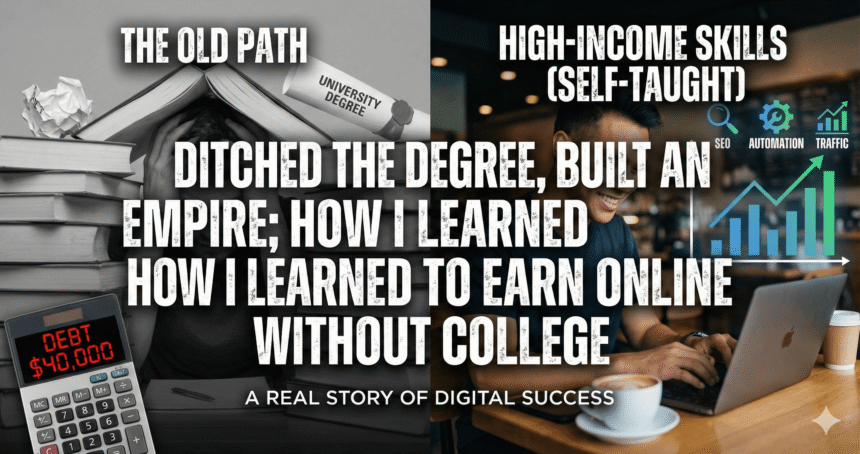
I was sitting at my kitchen table at 3:00 AM, the only light coming from a laptop screen that seemed to be mocking me. On one tab, I had a student loan balance that looked like a phone number. On the other, a job application that required a “Bachelor’s degree” just to answer phones for $15 an hour. I realized I needed to learn digital skills without college.
I felt trapped. I remember the physical weight in my chest—that cold realization that the “path” I was told to follow was a dead end. I had no degree, no “connections,” and my bank account was a sea of red. I felt like the world was a club I didn’t have the membership card for.
But that night, out of pure desperation, I stopped looking at job boards and started looking at what people were actually paying for. That was the moment I stopped trying to be “qualified” and started trying to be “useful.”
The Day I Realized “Learning” Isn’t the Same as “Studying”
When I first decided to skip college and learn digital skills, I made a massive mistake. I bought three $200 courses on everything from coding to marketing. I spent weeks watching videos, taking neat notes, and “studying” like I was back in high school.
I thought I was making progress. But when I actually tried to build a simple website, I froze. I knew the theory, but I didn’t know how to fix a broken plugin or handle a traffic spike. I had the head knowledge, but my hands didn’t know what to do.
The Lesson: Stop being a professional student. In the digital world, nobody cares what you “know”; they care what you can build. How to apply it: Spend 20% of your time watching a tutorial and 80% of your time actually clicking the buttons. If you’re learning SEO, don’t just read about it—start a site in a high-CPC niche (like insurance or health) and try to make one post show up on Google.
RELATED POST : How to Make Money Online in 2026: The Definitive Guide to Digital Income & Side Hustles
How to Learn Digital Skills Without College
The Mistake That Cost Me Three Months: Chasing the Wrong “High Income”
I used to think “high-income skill” meant I had to be a coding genius. I tried to learn deep-level Python because I heard it paid well. I hated every second of it. I struggled; I felt stupid, and eventually, I just stopped opening my laptop for weeks.
Then, I realized something. You don’t need to be a programmer to make $300 to $1,000 a day. You need to understand traffic and intent.
I shifted my focus to high-value niches—things like scholarships and finance. I realized that writing about a “cheap hobby” pays pennies, but driving traffic to “Health for Seniors” or “Global Scholarships” targets high-RPM audiences in the USA and UK. Suddenly, the “work” felt like a game I actually wanted to win.
The Lesson: Don’t pick a skill just because a “Top 10” list said it pays. Pick the one that helps you own the traffic. How to apply it: Test-drive different content niches. If you find yourself obsessed with tracking analytics and seeing which Pinterest pin went viral, you’re a traffic strategist, not just a “blogger.”
The “Automation” Breakthrough (My Small Win)
For a long time, I was drowning in manual work. I was trying to write every post, edit every video for my YouTube channels, and post to Quora and TikTok by hand. I was burnt out by noon.
The real shift didn’t happen until I discovered n8n and automation. I was terrified of it at first—it looked like NASA software. But once I set up my first workflow to help me scan keywords and generate drafts, it was like I hired a team of five people for free.
The Lesson: A skill is high-income when it’s scalable. Learning to use AI and automation tools to do the “grunt work” is what separates the $20/hour freelancers from the $500/day owners. How to apply it: Don’t just learn “how to write.” Learn how to use tools like Gemini and n8n to build a content machine that works while you sleep.
The Simple Thing I Almost Ignored: The “Proof” Folder
I used to be terrified of not having a “real” portfolio. I didn’t have clients, so I didn’t have proof. I was stuck in a loop of “I’m not ready yet.”
One afternoon, I just took screenshots of my own wins. I showed a TikTok video that got 10k views, a Quora answer that drove 500 clicks to my site, and a screenshot of my AdSense dashboard (even when it was just $5).
When I showed people actual results from my own projects, they didn’t care about my resume. They wanted me to do for them what I had done for myself.
The Lesson: Your own websites and YouTube channels ARE your degree. How to apply it: Treat your personal projects as “Client Zero.” Every win you get for your own brand is a case study you can use to land high-paying consulting gigs later.
Mistakes Most People Still Make
-
Waiting for Permission: Waiting for a certificate before they start. The market is the only thing that can certify you.
-
The “Broad” Trap: Trying to learn “Social Media.” No—learn “Viral Traffic for High-CPC Websites.” Be specific.
-
Ignoring the “where”: They write for everyone. I learned that 100 visitors from the USA are worth more than 1,000 from elsewhere if your goal is AdSense.
ALSO READ :High-Demand Jobs in 2026: The Ultimate List of Future-Proof Careers & Remote Opportunities
Where Things Stand Now
I’m still growing. I still have days where the “Search Console” graph goes down and I feel that old familiar panic. But the difference is that I’m no longer a victim of the “degree trap.”
I have a set of skills that the market actually wants. I can build a brand, automate a workflow, and drive traffic to any niche I choose. I went from being “unqualified” to being an owner by simply choosing to learn by doing.
You’re Closer Than You Think
If you’re sitting where I was—feeling like you’re standing outside a locked door—please listen: The door isn’t locked. You’re just trying to use a key (a degree) that doesn’t fit the modern world.
Pick one niche today. Start one channel. Automate one task. The momentum of that first “small win” will carry you further than four years in a classroom ever could.
Be the first to get new scholarships, job updates, inspiring Fazza poems, lifestyle stories, and more — straight to your inbox.